Prompt Architecture as Code: The Database That Writes Our Generative Art Prompts
Ask most people what a production AI-art pipeline looks like and they imagine someone typing clever sentences into a chat box. Here is what ours actually looks like: a relational database, a deterministic compiler, a three-layer cache, and a regression suite that fails the build if a rendered prompt changes by a single byte.
Nobody at FabledPaws writes prompts by hand. This article explains why we treat prompts as compiled artifacts — and the four engineering problems (plus one core doctrine) that forced us into this design.
The Combinatorial Wall
Our catalog is deceptively small: 14 themes, roughly a hundred outfits, eight personality vibes, two subject species, and a long tail of breed morphologies. Multiply it out — theme × outfit × vibe × species × breed-specific physical adjustments — and you get a combinatorial space in the hundreds of thousands, each combination producing a different valid prompt. Prompt length varies; clause order varies; guard clauses attach and detach depending on context.
No human can write, QA, and maintain that corpus as text files. And even if you could, you would discover the same thing we did the hard way: at production scale, a prompt is not a sentence. It is a build artifact. It needs a source of truth, versioning, deterministic compilation, caching, and regression tests — everything code has.
The Layered Schema
Every prompt we render is assembled from five semantic layers stored as data in PostgreSQL:
[CORE_SUBJECT]+[POSE_ANCHOR]+[COSTUME_LAYER]+[ENVIRONMENT_LIGHT]+[NEGATIVE_SPACE]
- Core subject — the animal, expressed through recognition output: breed, coat, markings, head geometry, plus physical qualifiers.
- Pose anchor — the body configuration, locked per theme. This layer exists because diffusion models drift toward generic "sitting dog" poses; pose anchoring is what makes a throne portrait read as enthroned rather than sitting near a chair.
- Costume layer — the outfit: garments, materials, and its own rules for how it interacts with the body underneath.
- Environment and light — the theme's world: palace, locker room, boardroom, and the light that comes with it.
- Negative space — the structured exclusion list that keeps known failure modes out of the frame.
Each layer lives in its own table row as structured JSON — expression matrices, pose text, accessory fields, species-specific overlays — joined at render time by a compiler that walks the schema and emits the final prompt byte-for-byte identically every run. Marketing edits rows; the compiler handles composition; nobody touches prose.
Four Problems That Shaped the Architecture — Plus One Doctrine
The five-layer schema is not an aesthetic choice. Each layer earned its existence by solving a specific, expensive failure. Here are the war stories.
1. Feature Bleeding: The Red Coat That Dyed the Dog
Put a Golden Retriever in a crimson royal robe and the model, eager to reconcile "red" with "fur," sometimes dyes the coat itself a soft rose. We call this feature bleeding: an attribute from one layer contaminating a surface it does not belong to.
The fix is a doctrine with three prongs. First, never name the fear in positive space — a sentence like "the dog's fur remains golden" actively primes the model to consider non-golden fur. Positive clauses describe what should exist; feared outcomes live exclusively in the structured negative layer. Second, paired guard tokens — scope markers that wrap costume clauses so layer boundaries are syntactically explicit, and the compiler refuses to emit a costume block whose guards don't balance. Third, layer-specific negative clusters — exclusion lists compiled per active layer rather than one global blob, so costume-level exclusions never dilute anatomy-level ones.
The same pattern generalized everywhere: a white chest patch near an open neckline reads as anatomy it should not be; a lace collar whispers "skin" to the model unless the lining is described as a stiffer medium. Layered language, scoped and guarded, is what keeps surfaces in their lanes.

Before: the open square neckline invites the model to fill the gap with bare chest fur — and at print size, the composition reads as anatomy the subject does not have. Review flagged the entire batch.
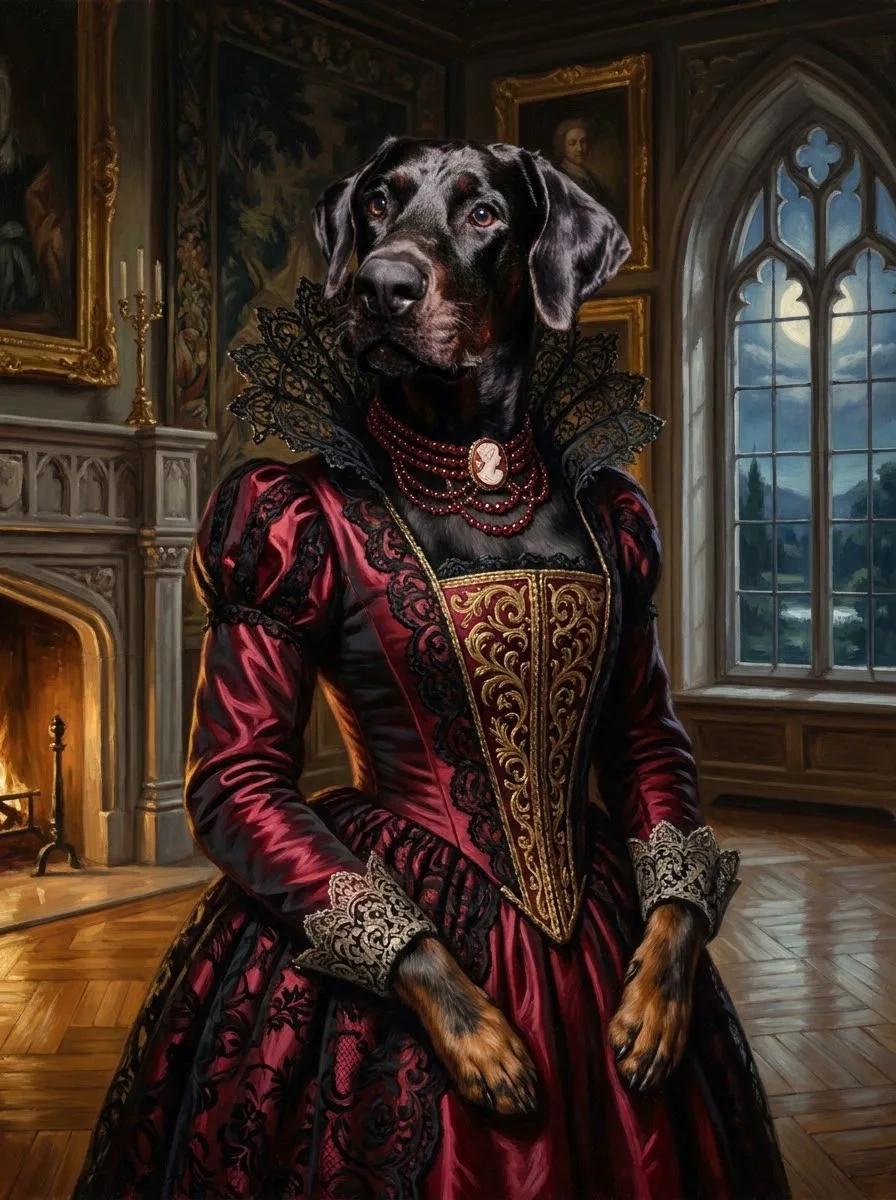
After: instead of fighting the neckline, we gave the chest a job — a lace partlet and a structured stomacher panel occupy the surface, and the anomaly is structurally impossible.
2. Morphology vs. Costume: Rules With Exceptions
Costume rules that ignore anatomy produce absurdity. Our crown logic historically stripped headwear from broad-faced, floppy-eared breeds — correct for a Greyhound in a tight helm, wrong for a Golden Retriever whose ears simply... hold the crown differently. The fix was not a special case; it was making morphology-aware exemptions a first-class rule type in the schema, so costume rules can declare which physical profiles they yield to.
The inverse failure taught us the same lesson from the other side: when a pose asked a paw to gesture, models kept replacing the paw with a hand. The cure was a prop anchor — give the paw a job (resting on a cane) and the anatomy resolves correctly. The schema now supports pose-and-prop coupling as data.
3. Coupled Attributes: The Mouth Lock
Expression is not one attribute; it is a coupled system. Our "solemn ruler" vibes require a closed, composed mouth — but the theme's environment text mentions grandeur, and somewhere in the composition the model finds an excuse to open the jaw. The compiler solves this with expression locking: when a vibe's whitelist marks mouth geometry as locked, the pose layer and the negative layer both receive coordinated clauses from the same decision — one source of truth, three coordinated emissions, no drift between layers.
4. Determinism: When a Tie Flipped the Output
The nastiest bug we ever chased looked like a model upgrade regression: customers reported subtly different portraits for identical configurations. The cause was a database query with a non-deterministic ordering — two outfit rows with equal sort weight swapped physical read order after a routine update, and the compiler, faithfully as ever, emitted a different-but-valid prompt. Same input, different art.
That incident gave us our most important rule: every rendered prompt must be byte-stable across runs, deploys, and cache layers. Explicit total ordering on every query. A three-layer cache (in-process memory → Redis → database) keyed by content version, so a marketing copy edit bumps a key and propagates in seconds instead of hiding in some layer's stale memory. And a regression suite of golden-output snapshots across species × theme × vibe combinations: any engine change that perturbs a single byte of a rendered prompt fails the build and must be justified.
Determinism bought us one more thing for free: fail-fast over silent fallback. If a human-subject order arrives without its recognition data, our system refuses loudly rather than quietly rendering a pet. Degradation that hides from your metrics is worse than downtime.
5. Personalized Anchors and the Honest Unknown
The core-subject layer is fed by recognition output, and we recently extended it with biometric qualifiers: sex, life stage, and a short head-geometry profile. These anchors dramatically improve portrait believability — a senior Golden Retriever should read as senior; a fluffy long-haired cat usually should not be assigned a guess about anything.
Which is why the doctrine matters more than the fields: a wrong anchor is worse than no anchor. Sex determination from a single pet photo is genuinely unreliable for many breeds and most cats; instead of letting the model guess, the schema whitelist-validates every recognition field and falls back to an explicit unknown — which compiles to nothing at all. Zero anchoring. The pipeline would rather render an unanchored truth than a confident fiction, because customers forgive absence but they screenshot errors.
This is a small thing that scales: every field that enters the prompt corpus passes a validation boundary with typed fallbacks. The compiler never sees raw strings it did not expect, which means the blast radius of bad input is a missing qualifier — never a malformed prompt.
What We'd Tell Our Past Selves
If you are building anything generative beyond hobby scale, our condensed advice:
- Store content as data, render with code. Prompt text in code is a bug farm; prompt inputs in a database with a compiler over them is a product.
- Make layer boundaries syntactic. Guard tokens and paired delimiters let the compiler enforce structure, not just concatenate.
- Positive space declares; negative space defends. Never mix the two.
- Determinism is a feature. Byte-stable outputs make caching, diffing, testing, and customer support possible.
- Golden files over vibes. If your regression suite can't detect a one-word prompt change, you don't have a regression suite.
None of this diminishes the model — it is the artist. But around every good artist, a serious studio builds scaffolding. Ours happens to be made of schemas and tests.
FabledPaws turns one pet photo into museum-grade canvas art — build your free preview here, or browse finished work in our inspiration gallery.